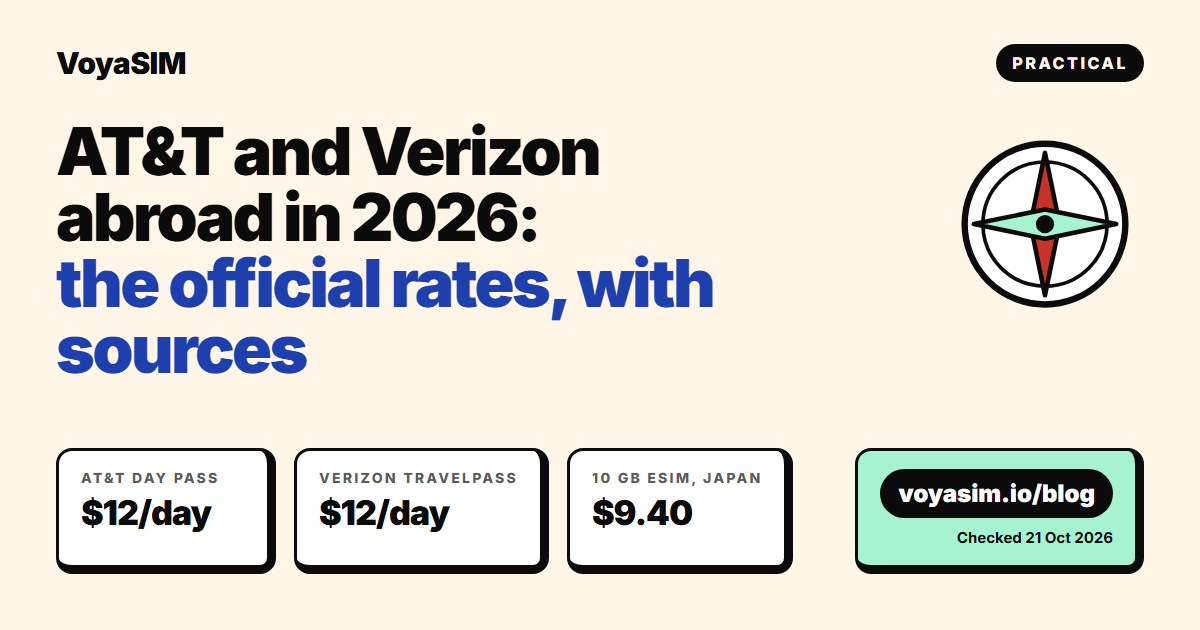
In 2026 both big US carriers price international roaming by the day: AT&T's International Day Pass is $12 per line per day ($6 for each additional line on the same day, $20 on cruise ships) and Verizon's TravelPass is $12 a day in 210+ countries or $6 a day in Canada and Mexico, with a $100 monthly plan for longer trips, all read from the carriers' own pages on October 21, 2026. T-Mobile includes slow-speed roaming on its postpaid plans. A two-week trip to Japan costs $168 on either day pass; a 10 GB VoyaSIM Japan eSIM for 30 days costs $9.40.
The official 2026 rates
Roaming prices are easy to get wrong because the carriers change them quietly and most comparisons online copy each other. These figures were read from the carriers' own pages on October 21, 2026; the links are in the sources.
| Carrier | Product | Price | Notes |
|---|---|---|---|
| AT&T | International Day Pass | $12 per line per day | $6 per day for each additional line on the same calendar day; 210+ destinations; $20 per day on cruise ships (land and sea) |
| Verizon | TravelPass | $12 per day | 210+ countries; $6 per day in Canada and Mexico; charged only on days you use the phone abroad; data is blocked automatically at $500 of unbilled usage |
| Verizon | International Monthly Plan | $100 per month | 20 GB of high-speed data, unlimited texts, 250 minutes; Verizon describes it as ideal for trips of 9 days or longer |
| T-Mobile | Included on postpaid plans | $0 per day | Unlimited texting and data at reduced speeds in 215+ countries on most postpaid plans; higher tiers include a high-speed allowance (reported as 5 GB or 15 GB depending on the plan); calls $0.25 per minute. T-Mobile's pages blocked our read on October 21, 2026, so the figures come from two independent write-ups that agree |
A day pass is charged when the phone first uses data, calls or texts abroad on a given day, and the day runs 24 hours from that moment. Two days abroad with one message on the second morning is two charged days.
What a real trip costs
The math is simple because the passes are flat. For one phone:
| Trip | AT&T Day Pass | Verizon TravelPass | Verizon monthly plan | VoyaSIM eSIM (live, Oct 21, 2026) |
|---|---|---|---|---|
| 4 days in Paris | $48 | $48 | $100 | 3 GB, 15 days: $4.20 |
| 10 days in Japan | $120 | $120 | $100 | 10 GB, 30 days: $9.40 |
| 14 days in Europe, four countries | $168 | $168 | $100 | 10 GB, 31 days: $8.40 |
| 14 days, two phones | $252 (second line $6) | $336 | $200 | 2 × $8.40 |
The pass gives you your own number for calls and texts abroad, which the eSIM does not. If that matters to you, the hybrid setup below gives you both for a few dollars.
The setup most frequent travelers use
- Keep the carrier SIM in the phone, so your US number keeps receiving calls and the bank's SMS codes. Most carriers deliver texts abroad for free; check yours.
- Switch data roaming off on the carrier line. This is the step that matters: with roaming off, the carrier never sees a data session and never charges a pass. Incoming calls you answer may still be charged at the pass rate on AT&T and Verizon, so let unknown callers go to voicemail and call back over Wi-Fi.
- Add a prepaid travel eSIM for the destination and select it for mobile data, with its own data roaming on. It installs from a QR code in two minutes (how to install on iPhone, on Android) and starts counting only when it first connects at the destination.
- Make calls over data. WhatsApp, FaceTime and Google Voice calls ride on the eSIM's data for free; the carrier's day pass is for the rare call that has to come from your number.
Where the carrier pass still wins
- One- or two-night trips where $12 is not worth a setup, or any trip where you will be on the phone with clients from your own number all day.
- Cruises: AT&T's $20 pass covers land and sea on 400+ ships; a travel eSIM works in port, not at sea.
- Canada and Mexico: most AT&T and Verizon plans include them free or at $6 a day, which is competitive with an eSIM for a short trip.
Everything else, from a week in Europe to a month in Asia, the prepaid eSIM is five to ten times cheaper, and the data is yours to use rather than metered against a cap. Prices above are the carriers' list prices for a single line; promotional plans, business accounts and older grandfathered plans differ, which is why each number above links to the page it came from.
Frequently asked questions
How much is AT&T International Day Pass in 2026?
$12 per line per day on land in more than 210 destinations, $6 for each additional line on the same account used on the same calendar day, and $20 a day on cruise ships, according to att.com on October 21, 2026.
How much is Verizon TravelPass in 2026?
$12 a day in 210+ countries and destinations, $6 a day in Canada and Mexico, charged only on days the phone is used abroad; Verizon also sells a $100 International Monthly Plan with 20 GB of high-speed data for trips of nine days or longer, per verizon.com on October 21, 2026.
Can I keep my US number and still use a travel eSIM?
Yes. The travel eSIM carries data only and sits next to your carrier SIM; your number keeps receiving calls and texts. Switch data roaming off on the carrier line so it never buys a day pass by accident.
When is the carrier pass the better deal?
For a one- or two-day trip where convenience beats cost, or when you need your US number for calls all day. For anything longer than three days, a prepaid eSIM is cheaper by a wide margin.
Sources & methodology
Plan prices on this page come from the live VoyaSIM catalog. Every other figure was checked against the sources below as of October 20, 2026.